This semester in my biology class I am edoing a project called 20 time. This means tha we use 20% of our time to pursue our interests, and use the scientific method to solve a problem. I asked the question, "How can I momorize new things more efficienty?" My poject will involove reasearching, and testing different memorization tequniques. I chose this because I think that my results will be very helpful for me, and many other high school students. This project shouls andswer my qustion of "How can I momorize new things more efficienty?" through a combination of reasearch, and testing. My goal is to rank defferent methods of studying by how effective they are. I can measure my prgress in how far along I am in testing methods for the first few moths, the my progress can be measured by how much these help people. My plan is to do some reasearh on methods of learning for the first few weeks, then to test them, and rank them based on how effective they are.
Monday, February 29, 2016

Thursday, February 25, 2016
Unit 7 reflection
I still want to know more about what is currently being don to lessen the impact humans have on the plant, and how the world will be like in 100 years if we don't change how we interact with the environment.
The consecration biology project went pretty well for me. Our groug worked well together, and create a pretty good end result(see above). I found that I am an assertive person, which is good, but also that I am a little passive aggressive. I need to work on that a little the next time I do group work. I need to be a little nicer to people that I don't like as much, and be willing to compromise more.
Sunday, January 24, 2016
Unit 6 Reflection
In this unit we learned about bio technology, which is the manipulation of living things or their parts to benefit mankind. This field of study include 4 main domains:

I learned a lot from these labs. They taught me what biotech was like in the real world insted of a sheltered classroom setting.
I still want to learn more about the future of biotech, and how far we are from the world of being able to engineer our children.
- Industrial & environmental
- This domain focuses on the production of materials from living things.
- Ex: fermentation of foods and beverages, biodegradable plastics, bio fuels
- Medical & pharmaceutical
- This domain focuses on medicines and vaccines from living things
- Ex: medicines and vaccines from plants and fungi, gene therapy
- Agricultural
- This domain focuses on the breeding of plant and animal for human consumption
- Ex: trans-genetic organisms, GMOs
- Diagnostic research
- This domain focuses on the understanding of our genetics, and using for comparison
- Ex: DNA identification
One of the aspects of Biotechnology that we talked about was bioethics, which about how to decide whether or not to use a technology. This was a very interesting unit, because it brought up the future of where bio tech could take us. There may be a point where we can genetically engineer our children, and eliminate all genetic disorders. We would then have to decide whether or not to allow children to be engineered, and that is a very tough question.
Some of the technologies we learned about were recombination DNA, which is the process of modifying a plasmid, gel electrophoresis, which allows you to sort DNA by length, and PCR, which creates tons of copies of a DNA segment.
My main strengths were electrophoresis and rDNA, I was less solid on PCR and the domains of biotech but my studying help me a lot.
We did a lab where we isolated different dyes in different candies and compared them to samples using gel electrophoresis. More information here.
We also modified a bacteria to make it glow green in our pGLO lab
I learned a lot from these labs. They taught me what biotech was like in the real world insted of a sheltered classroom setting.
I still want to learn more about the future of biotech, and how far we are from the world of being able to engineer our children.
My New Years Goals were to get better grades by studying more. I have started that by beginning my studying process, but I still need to tailor my studying to what works for me.
Friday, January 22, 2016
pGLO
pGLO Observations , Data Recording & Analysis
|

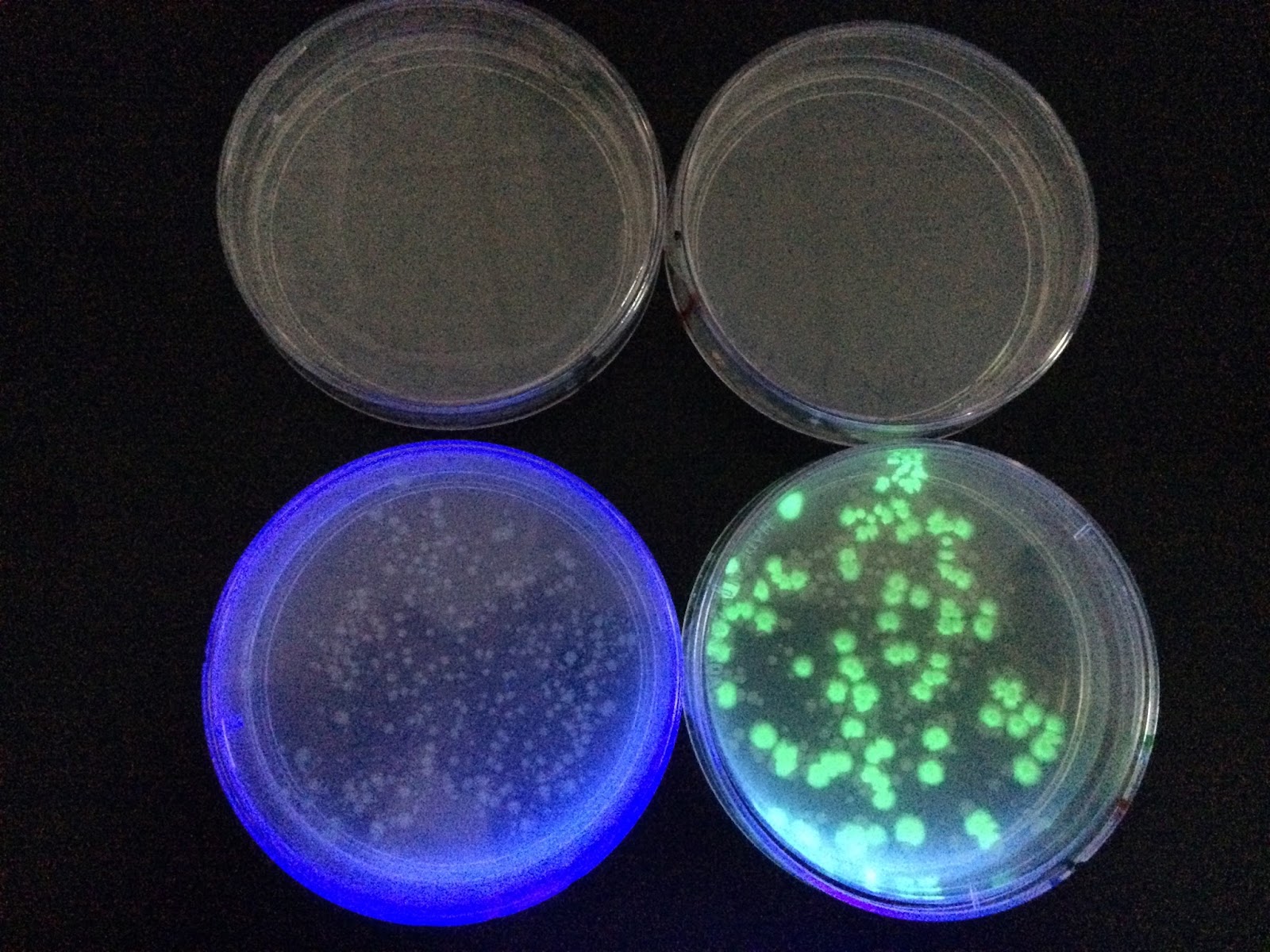
In our test, the bacteria gained the traits of ampicillin resistance, and the pGLO gene, which makes them glow green when exposed to arabinose sugar.
| ||
We spread 100uL of bacteria on the petri dish, and in that 100uL estimate that there are roughly 1500 bacterium in 100uL because there are 150 colonies on the the one with ampicillin ,and the gene. There are at least to times as many bacterium on the plate with only lori broth, so the must be atlast 1500 bacterium in the 100uL.
| ||
The arabinose sugar allows the GFP gene to be repressed. When it is present, it attaches to the repressor for the GFP gene, and prevents it from attaching to the GFP operator, which allows the GFP gene to be expressed.
The GFP gene can be used to tell if an organism has also taken a gene the will not be expressed. You can tell if it absorbed insulin gene, if it glows green. It can also let you follow the movement of substances in an animal, and track the progress of cancer through a brain.
One other example of genetic engineering is our turkeys. The have been bred over the years to become as plump as possible.
| ||
Thursday, January 21, 2016
Candy electrophoresis Lab
In our experiment, all of the dyes moved in the same direction, lined up with a reference dye, and was both the same size, and color as a dye.
Yellow 6, Red 40, and Citrus Red 2 would migrate through the gel at roughly the same speed, because they are the same size. Blue 1 and Fast green FCF would also move together.

Dog food manufactures might put food coloring in their food, because if a dog thinks something looks weird, they wont eat it. The will only eat it if it looks appetizing.
Two factors that contribute to how far dyes moved is the length of the molecule, and the time we ran the gel for.
Electricity, and positive attracting negative pulls the dyes through the gel.
The fact the smaller molecules move faster allows the molecules to separate. If they didn't you would get on band across all the used lanes, but since they do you can tell relative lengths
If given molecules with molecular weights of 600, 1000, 2000, and 5000 daltons I would expect the 600 to go the farthest, followed by 1000,then 2000, and finally the 5000 would barely have moved.
Yellow 6, Red 40, and Citrus Red 2 would migrate through the gel at roughly the same speed, because they are the same size. Blue 1 and Fast green FCF would also move together.
Dog food manufactures might put food coloring in their food, because if a dog thinks something looks weird, they wont eat it. The will only eat it if it looks appetizing.
Two factors that contribute to how far dyes moved is the length of the molecule, and the time we ran the gel for.
Electricity, and positive attracting negative pulls the dyes through the gel.
The fact the smaller molecules move faster allows the molecules to separate. If they didn't you would get on band across all the used lanes, but since they do you can tell relative lengths
If given molecules with molecular weights of 600, 1000, 2000, and 5000 daltons I would expect the 600 to go the farthest, followed by 1000,then 2000, and finally the 5000 would barely have moved.
Wednesday, January 13, 2016
Recombination DNA
The first step to making recombination DNA is finding a plasmid and determining which antibiotic it is resistant to. You also have to identify the gene you want to add, for us we used the insulin gene, and sequencing it and the area around it. You then figure our which restriction enzyme can cut the plasmid in one location, and the DNA in two places, as close to the gene as you can. A restriction enzyme is an enzyme that looks for a specific dna sequence, and then makes a cut there. We used Xma I because it cut the plasmid in one location and the gene in two locations that were the closest to the insulin gene. If we had cut the plasmid in two locations we wold have removed part of the plasmid DNA, which we did not want to do. You then than ad lygase to re-join the plasmid. Finally you re-insert the plasmid into a bacteria, and add the antibiotic you determined the plasmid was resistant to, for us it was tetracyline. This kills all bacteria except the one you modified. Finally, you let the bacteria multiply.
This is important in every day life, because it is used to create many vaccines and medicines, by making bacteria that can produce these products. This technology can also be used to create GMO foods, such as fruits that spoil more slowly.
This is important in every day life, because it is used to create many vaccines and medicines, by making bacteria that can produce these products. This technology can also be used to create GMO foods, such as fruits that spoil more slowly.
Monday, January 4, 2016
New year's goals
I will improve my test grades by studying more for my tests.
- I will start by setting aide time to study.
- I will make this time free of distractions.
- I will tailor my studying to my personal study style(visual, and kinesthetic)
- I will study for at least an hour before every major test by the next bio unit test.
- I will make my studying more effective by tailoring to my own needs, and by finals, i will be an effective studyer
I will make finals in one robotics tournament.
- i will do this be working on the robot more
- i will include others in the team more
- i will work more seriously during the meetings
- i will focus at the tournament
Subscribe to:
Posts (Atom)