Wednesday, November 18, 2015

Unit 4 refection

This unit was about reproduction, specifically sexual reproduction. I specifically learned the differences between sexual and asexual reproduction, how sex works, and what happens before sex(meiosis, and its steps). We also learned about inheritance, This involved using punnet squares to calculate the probability of offspring having certain traits based off their parents' genotypes. We also learned about dominant, and recessive alleles, which is when one allele is shown over another. Mendel discovered the characteristics and laid down the foundations of genetics. We also learned about some more complicated topics in genetics such as gene linkage, and epistasis.

My main strengths were punnet squares,mitosis and meiosis. My weakness is that i don't quite understand some of the more complected terms yet, and could still use some review on them. Doing the info graphic helped me a lot. It help with both the content side, and the time management side. On the content is was both a test of what I knew, and a review on what I didn't. I had to explain the concepts, so I had to be solid on them, which held me accountable for knowing them.

I still want to know more about genetic mutations. Genetic mutations ave always fascinated me, and the weren't talked about muck in this unit. 

I took a VARK Questionnaire to see how I should be studying, and what type of a learner I am. The results were as I expected, I was more kinesthetic(13), and visual(11), than read/write(6) and aural(2). The useful part of the survey was the studying tips. It recommended that I find/draw diagram and that I go back over what i did in labs. I intend to try both of theses new methods of studying on the new test

Tuesday, November 17, 2015

Coin Sex Lab

In this lab we learned how to use punnet squares to predict what traits our offspring will have, and how these prediction can deffer from what actually will happen. In this lab we used coins to represent genes, and the two sides of the coin represent the two different alleles for the gene. The flipping of the coins represents meiosis, and the two sets of coins up represents the processes of recombination. The coins also showed how probability of something happening can be different from what actually happens. We did multiple autosomal crosses, where the sex chromosomes are not involved, and one x-linked cross, which is when the sex chromosome are involved. We used two sets of one coin each to represent monohybrid crosses, and two sets of two coins each to represent dihybrid crosses. In some of our tests we labeled both side of the coin the same way to represent a homozygous trait, but in others we labeled the two sides differently to represent a heterozygous trait.

When we preformed the di-hybrid cross, we got results that were slightly different than what was expected. The punnet square gave us a phenotype ratio of:

9 Brown Hair, and Brown eyes : 3 Blond Hair, and Brown eyes : 3 Brown Hair, and blue eyes :
1 Blond Hair, and Blue eyes

Our experiment had slightly different results, and gave us the phenotypic ratio of:

8 Brown Hair, and Brown eyes : 4 Blond Hair, and Brown eyes : 2 Brown Hair, and blue eyes :
2 Blond Hair, and Blue eyes

The slight difference between the probability, and what actually happened is due to the fact that probability, and reality do not always line up. It possible to cross two heterozygotes, and get two recessive alleles in all ten offspring for the same reasons that you can flip a coin ten times and get heads every time. This lab demonstrated the limits of probability. Probability can give you odds on what can happen, but until the event occurs you have no idea what will happen. Relating back to the coin, the probability of getting heads two heads in a row is a 25% chance, but until you flip the coin twice you can't know if you will get two heads.

This lab relates to me because if/when I have children, then I cant use probability to predict what they might be like, but I have no way to know for sure what traits they will have, until they are born.

Tuesday, November 10, 2015

Genetics Infographic


Because in this layout my info graphic appears very small, to view it in full size click here.


Sunday, October 18, 2015

Unit 3 reflection

This unit was about what is inside a cell, and what cells do. It included photosynthesis, cellular respiration, and osmosis. This unit also mentions how cells were discovered, and how cells changed over time. The main theme of this unit was that cells are the building blocks, and the ways cell use their organelles, and processes to communicate, and survive, and create life. One other key concept was how the structure of a cell affects its function. My main strength was the organelles, and osmosis, because I feel like I really understand them, and can explain them. My main weaknesses would be photosynthesis and cellular respiration, because while I mostly understand them, there are a few details I still don't understand fully.

I learned a lot about cells, and also about good lab procedure. I learned how to find errors in an experiment, and come up with ways to fix them. I also got a little better at getting through the vodcasts without pausing. Finally I learned new ways to get through difficult material.
IMG_0957.JPG
I still want to learn more about photosynthesis, and how it works at a deeper level. At a more broad level I find it amazing how life evolved from tiny bacteria to big multi-cellular organisms that will have the capability to learn, and study the tiny cells they are made of. I also love concept of osmosis, and how quickly a cell will change based on its surroundings. If I have time I might try duplicating one of the experiments at home, but with slight modifications.


IMG_0956.JPGIMG_0955.JPG


I normally study minimally for test, but for this one I plan to at the minim review photosynthesis and cellular respiration through the CFUs, vodcast notes, and the diagrams. I will also take the CFUs again, and review any other difficult concepts based on what I get wrong.

Wednesday, October 7, 2015

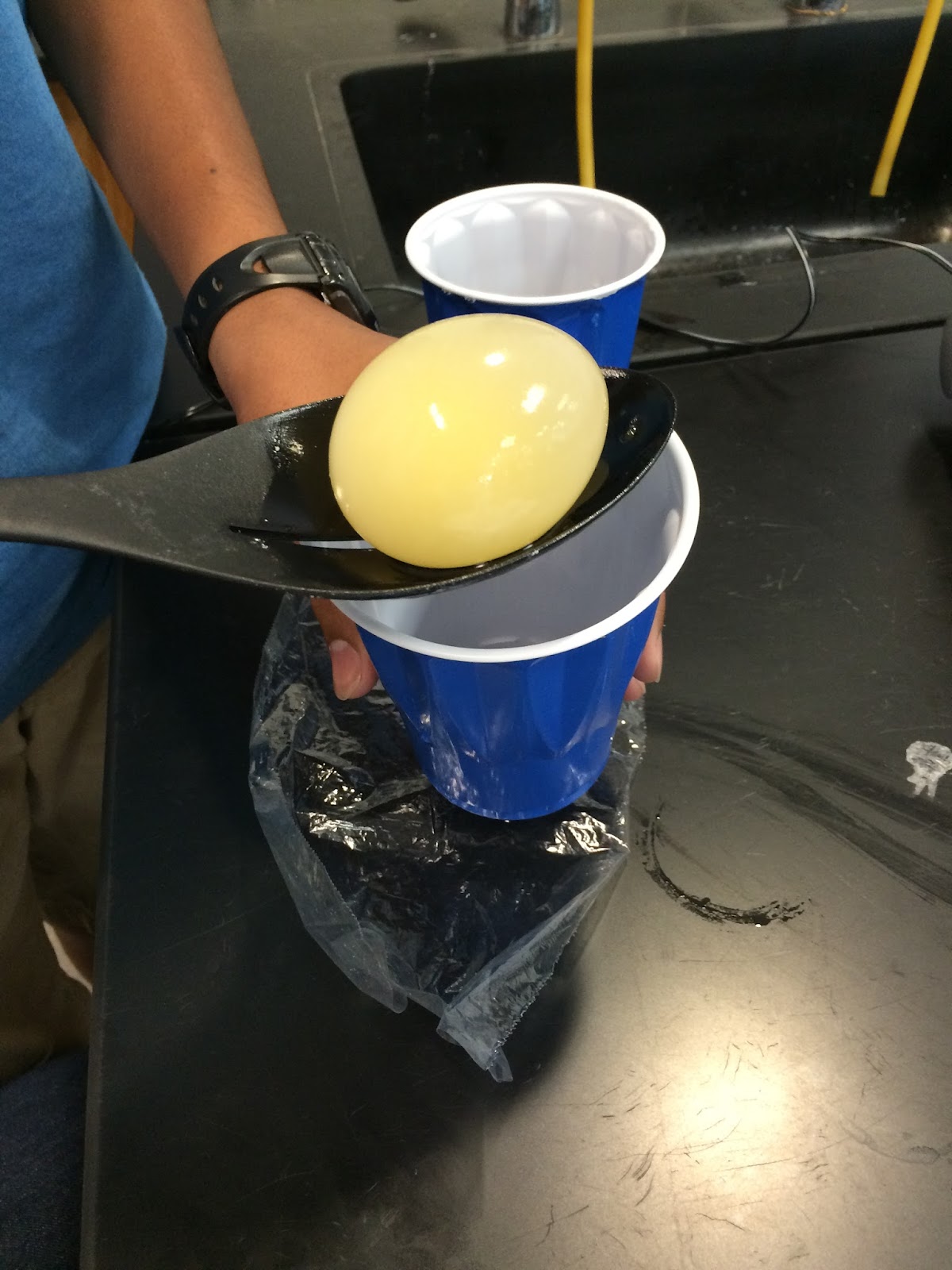
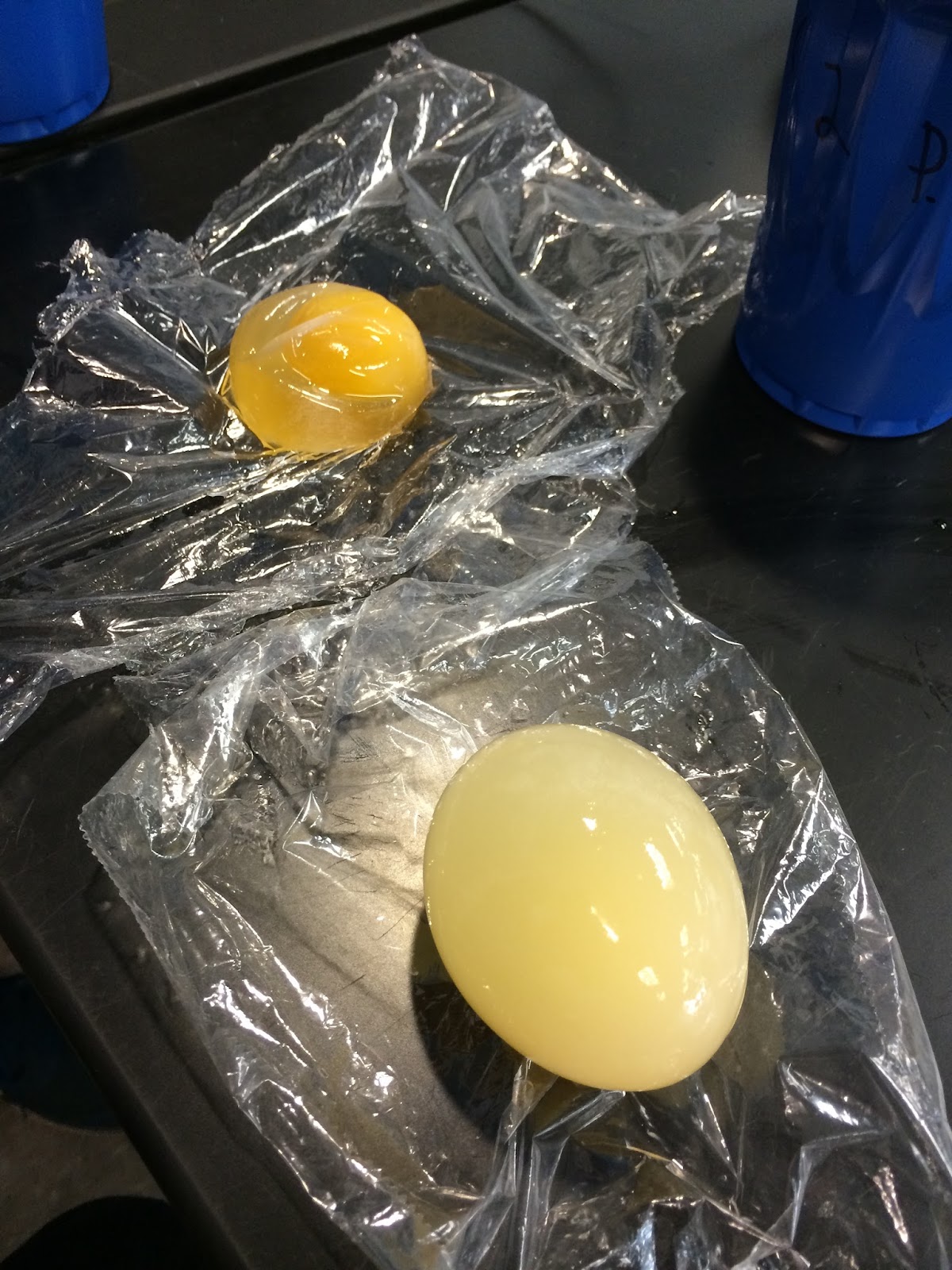
Egg diffusion lab

Friday, October 2, 2015

Egg Macromolecules

In this lab we looked a cell to determine which macro molecules are found in which parts of the cell. To do this we took an egg, and separated it into the yolk, white, and membrane. We then took each of these three components and used chemical identifiers to determine which macro molecules were  in which parts of the cell. We found that proteins are found in the egg white. This was shown, by when we added sodium hydroxide (NaOH) and copper sulfate (CuSO4), to the sample, and it turned a dark blue, which is an indicator that a protein is present. This makes sense, because egg whites are the food for the growing embryo, and cells need proteins to grow. The membrane contains lipids. We know this because, when we added Sudan III to the lipid it turned orange, which is a sign that a lipid is present. This data makes sense because all membranes are made of lipids. We also found lipids in the egg yoke.  We know this because, when we added Sudan III to the lipid it dark-ish orange, which is a sign that a lipid is present. This data makes sense because all membranes are made of lipids, and there is a clear membrane surrounding the egg yoke.

 One possible error in this lab was that when we tested the yoke for proteins, the sample turned green,which made it impossible to tell if it contained proteins. To remove this error I would mix the sodium hydroxide (NaOH) and copper sulfate (CuSO4) better. Another error is that when testing the membrane we cut it into one chunk. This only exposes the outside of the membrane, but not the inside. This led to us not finding proteins in the membrane, even though there were proteins in the membrane. To fix this error, I would cut the membrane into more, smaller, pieces before testing it.

This lab was done to further our understanding of macromolecules, and how they the building blocks of life. This relates to macromolecules, and also what makes up the different parts of a cell. This lab can be applied to future leaning about cells, and will allow me to make inferences about which macromolecules make up which parts of the cell.

Monday, September 28, 2015

20 big questions

One of the articles that interested me, was question about whether or not there were more universes. This was interesting, because if there are more universes out there, they might no abide by the same law of physics as us, and there may be advanced beings in them, and they might even be watching us. One hypothesis in this field is that If scientist are observing unexplained "dark flow" then other universes may exist.

My 20 big Questions:

  1. What happens after death?
  2. Are we the only planet with life on it?
  3. Will humans ever solve their population problems?
  4. Will humans ever solve energy problems?
  5. How long will humans survive?
  6. How did life start?
  7. How did the big bang start?
  8. Are humans just another being's experiment?
  9. Do people have free will, or are their action pre-decided? 
  10. Will humans ever live forever?
  11. Will there ever be a "better" evolution of humans?
  12. How does the human brain work?
  13. Is there a god?
  14. What will happen if a temperature reaches absolute zero?
  15. Will any other animals evolve the way humans did?
  16. Will time travel ever exist?
  17. What will happen when the sun dies?
  18. Will there ever be a nuclear was?
  19. What would lift be life after a nuclear war?
  20. Will computers ever reach a limit on how fast they can be?